Introduction
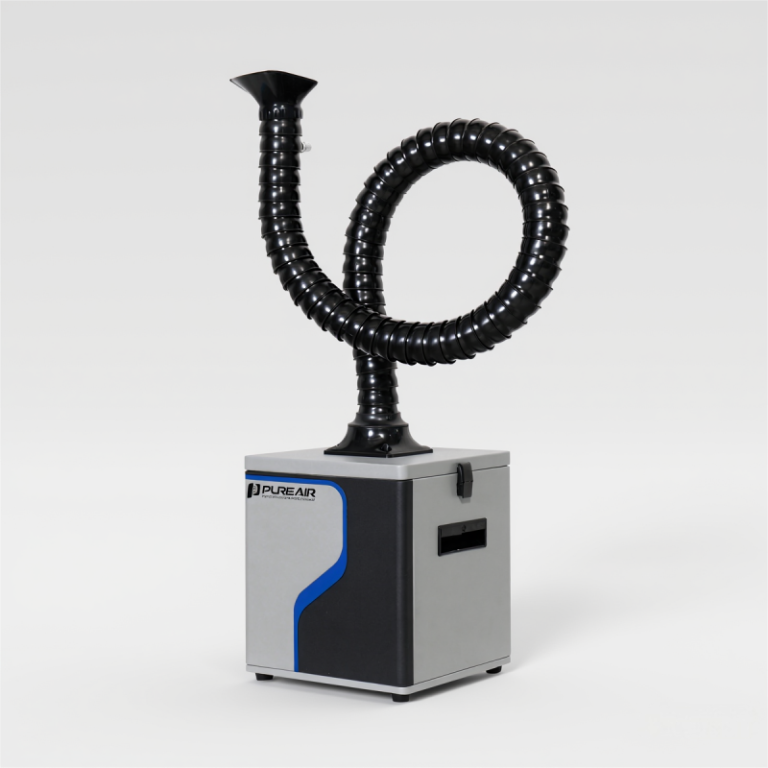
Have you ever paused and asked whether the air around a laser workstation is truly safe? Recent shop-floor surveys show particulate and VOC levels spike near marking heads during runs, and my own measurements back that up. In many facilities the solution on the floor is a laser marking fume extractor placed beside the laser; it helps, but not always enough. (We see readings jump during long cycles, and operators notice the smell.) Given this picture—what should engineers and managers prioritize when choosing extraction and filtration systems for marking stations? I’ll walk through practical comparisons, real faults I’ve seen, and clearer criteria you can use next.
Deep Dive: Traditional Flaws and Hidden Pain Points
industrial air purifier for dust is often offered as the straightforward fix for particulate problems, yet when I inspect installations I find recurring gaps. Many units rely heavily on HEPA filters and a single-stage fan. That works for dust, but not for mixed laser plumes with VOCs and ultrafine particles. HEPA filters capture particulates down to 0.3 µm well, but they do not remove gases—so activated carbon or catalytic stages are needed too. I’ve seen shops with clogged pre-filters, reduced airflow, and exhausted carbon beds; maintenance lapses then render the system far less effective. In short: traditional single-stage designs assume constant maintenance and steady loads—an assumption that rarely holds in daily use.
Why do these flaws persist?
Partly it’s cost pressure, partly it’s misunderstanding of the plume. Facilities buy a unit for dust and expect it to handle everything. They skip VOC sensors and ignore fan speed controllers that adapt to process load. Look, it’s simpler than you think: you need staged filtration (pre-filter → HEPA → activated carbon), reliable monitoring (VOC sensors, pressure gauges), and accessible service points. I also recommend thinking about power converters and edge computing nodes — not for their buzzwords but because a smart extractor with simple controls can log filter differential pressure and trigger alerts before performance drops. In my experience, those small tech additions reduce downtime and keep operators safer—funny how that works, right?
What’s Next: New Principles and Practical Choices
Looking ahead, I favor design principles that combine adaptable filtration with measurable controls. New systems pair modular media (replaceable carbon cartridges and HEPA cassettes) with inline VOC sensors and variable-speed fans. This lets you match extraction rate to marking intensity. When you revisit options for an industrial air purifier for dust, ask for data on filtration efficiency across particle sizes and for VOC breakthrough times of the carbon stage. Those figures tell you whether the unit will hold up over a week of variable work, not just in a short demo.
Real-world impact and selection tips
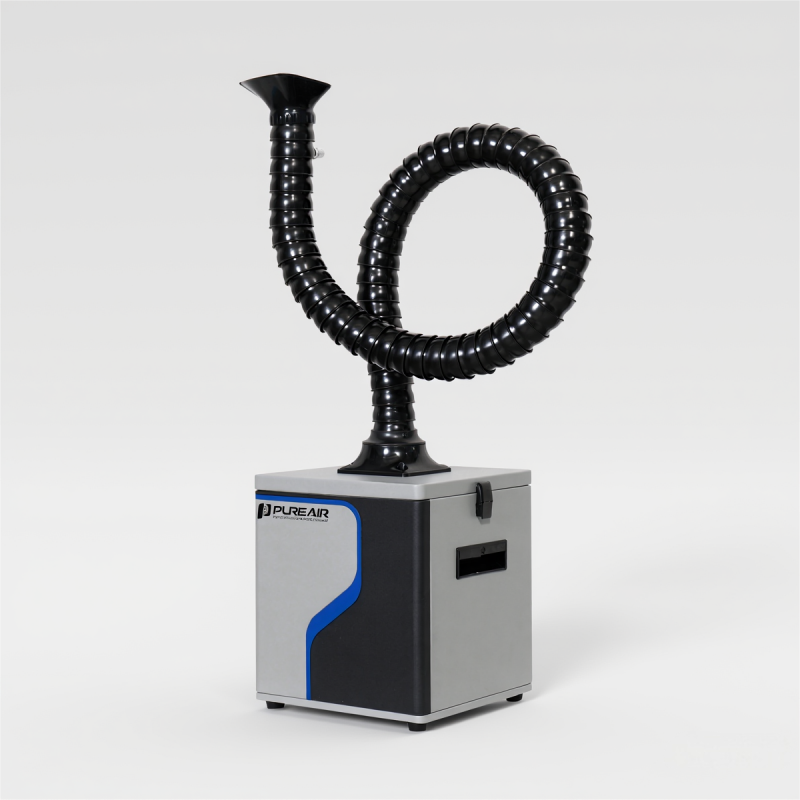
In practice, I compare systems on three fronts: measured capture efficiency at the source, serviceability (how easily staff can swap filters and access sensors), and intelligence (data logging, alarms, and simple controls). You want clear numbers—capture at nozzle, airflow in CFM, and time-to-VOC-breakthrough—not marketing phrases. Also consider integration: fan speed controllers and edge computing nodes can send alerts to the shop floor so maintenance is proactive. If you evaluate with those metrics, you will see differences that matter for operator health and for uptime.
To close with a practical checklist—because I like to leave people with something tangible—use these three evaluation metrics when choosing a solution: 1) Source capture efficiency (measured at the nozzle), 2) Combined media performance (particle + gas removal with documented lifetimes), and 3) Smart monitoring and service alerts (simple dashboards, alarms, or log exports). Those metrics help you compare apples to apples. We’ve used them in pilot installs and the results were measurable: fewer complaints, longer intervals between filter swaps, and clearer maintenance scheduling.
I hope these insights help you make choices that protect people and keep production flowing. For projects where I’ve advised teams directly, PURE-AIR has often been a practical partner in meeting these goals — they offer the modular options and monitoring I describe: PURE-AIR.